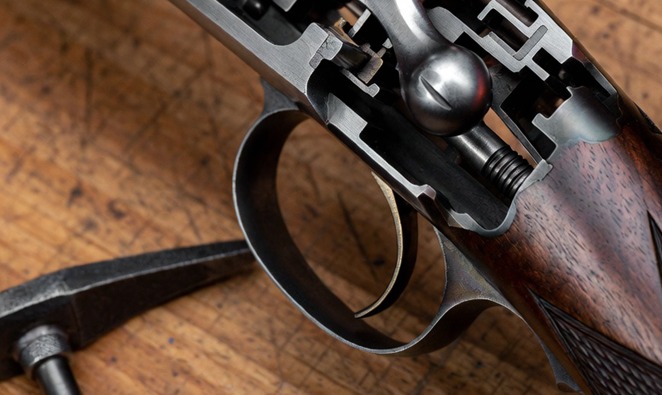
You open one of these actions and you can read it. Forty years of working on American single-shots — the Sharps 1874, the Remington Hepburn, the Winchester 1885, the Stevens 44 1/2 — and the first inspection tells you everything. Whether it has been left alone. Whether someone has been inside it. Whether whoever was inside it understood what they were looking at. You know within the first minute.
These actions were not designed the way modern firearms are designed. The safety is not a separate mechanism. It is in the geometry — hammer notch angle, sear engagement depth, load path through the action body. Each surface is doing specific work in relation to every other surface. Touch one without understanding the relationship and you have moved the failure point, not fixed it. And on a single-shot action under recoil, the failure point you cannot see is the one that ends the day badly.
"The thought process behind the action, and all it took to make it durable and strong enough to bridge the gap between black powder and smokeless powder. Most customers have never considered it."
The most common damage I find is to the hammer notch. Someone decided the trigger was too heavy and stoned it. Changed the angle, reduced the engagement depth. The pull dropped. The safety margin went with it. It does not always show on a function check — you have to measure the geometry against spec to see how far it has drifted. What you are looking for is intermittent engagement: a rifle that functions fine in hand but releases under recoil or lets the hammer follow the block down on a fast cycle. That is not a tuning problem. That is an unsafe rifle. An altered notch on one of these actions is a rebuild. You are cutting new geometry or replacing the component. You cannot put metal back.
Welded repairs are worse. A weld on original lockwork means heat into hardened steel, which means you do not know what you have. The case hardening on these actions is doing specific work — it is not cosmetic. When someone welds up a damaged surface to build it back, the heat-affected zone changes the material properties in an area you cannot fully inspect from the outside. My approach when I find it: assume everything in that zone is compromised, test accordingly, and replace if there is any doubt. A rifle that fails at the lockwork does not give a second chance.
"Taking one of these classics apart and finding the safety notch on the hammer altered, or something welded up by someone that shouldn't have been near a welder, rendering a beautiful classic rifle a pile of scrap metal."
The remediation is not a patch. You go back to original specification, use modern steel that meets or exceeds the original material, and cut the geometry correctly. That means understanding the geometry of the specific action first. The Hepburn's falling block has different engagement timing requirements than the 1885. They are not the same action and they do not get the same repair logic. Part of that knowledge is reading the original design intent — what the engineers were protecting against, where they put the margin, what they expected to wear first. I studied each of these designs specifically because there is no substitute for that knowledge. You can read about it. At some point you have to have enough of them on the bench that the failure patterns become immediate.
The same material discipline carries into my engraving work. My collaborative Hagn Rifle project with stockmaker Jerry Fisher required me to handle the pack hardening. Pack hardening is surface chemistry and heat control — get it wrong and you lose the engraving surface, or worse, compromise the receiver dimensions. The gunsmithing and the engraving are not separate practices. They run on the same requirement: know what the metal is doing before you touch it.
"The use of modern steel, quality wood, and technology, as well as first-rate workmanship and finishing practices, will always trump shoddy work and an old piece of coat hanger."
Three rules I apply to every job on these actions. If you do not understand the load path, do not touch the lockwork. If you find weld on original lockwork, treat the surrounding material as unknown — do not assume the base held, do not assume the hardness is where it needs to be, and do not pass the rifle back until you know. A weld that looks clean on the outside has already done its damage where you cannot see it. And before any work, study that specific action, not single-shots in general. The Hepburn and the 1885 were different engineering answers to the same question, and treating them the same way is how your repair becomes the next smith's problem.
Not everything is fixable for what the owner expects to pay, and that conversation belongs at the front of the job. If it cannot be done correctly, it does not get done. If it can, the standard does not move.
Can't do it right, don't do it. Forty years. Same rule.