The customer's request was about as short as they get: make it work.
The gun was a Rast-Gasser — an Austro-Hungarian service revolver, a design from the late 1800s that saw military use into World War I. Most shops won't touch one. I will.
What should have been a simple weld turned into a deep diagnostic check of other parts. That happens more than people expect on guns like this. You come in thinking you know what the job is. Then the gun tells you something different.
The hammer had arrived broken — the double-action dog pin to mainspring pin interface had failed completely, leaving the action dead. The obvious move was to weld it, fit it, return it. But I don't stop at obvious. On a gun this old, with this kind of history, a single failed component is almost never the whole story.
So I went deeper. Checked the other parts. Looked at what was there — and started asking what shouldn't be.
Inside the revolver, I found a homemade sear. Installed — and apparently functional in some fashion — for the better part of 75 years.
The owner didn't know it was there. Previous owners almost certainly didn't either. The gun had simply worked — intermittently, unreliably — and nobody had ever gone looking for why.
The homemade sear wasn't fitted properly. It would catch inconsistently. On some pulls the gun would function. On others, nothing. That kind of intermittent failure is the hardest to diagnose on any firearm — and on a century-old European revolver with an undocumented internal component, it becomes a puzzle with missing pieces and no picture on the box.
There's no factory diagram for what someone fabricated in a field or a back room decades ago. You're working from what you know the mechanism is supposed to do, then reverse-engineering what someone else decided to substitute — and why. Sometimes the reasoning was sound. Sometimes it was desperation. Either way, it's your job to figure out what's actually in front of you before you touch anything.
Original Rast & Gasser patent drawing. No diagram accounts for what gets added in the field.
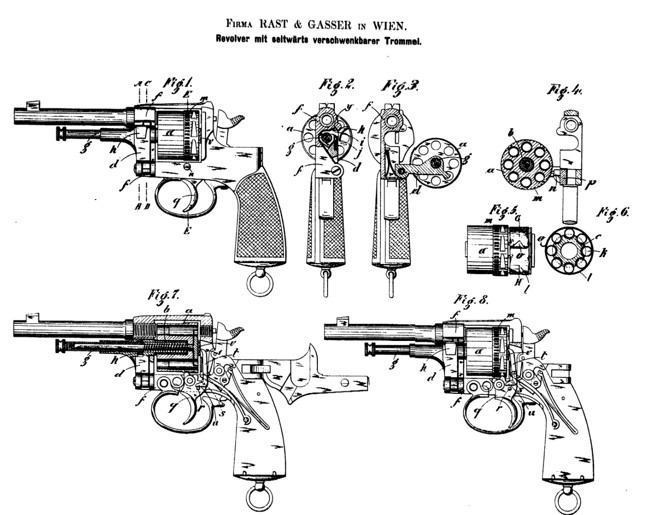
I made a new sear from scratch, fitted to the hammer pattern. The revolver now functions as it should. More hours of thinking than of welding. That's the job.
The lesson here isn't really about this gun. It's about the category.
It's hard to determine what should be there and what shouldn't be at times. That's the defining challenge of antique and collector work. There's no parts diagram that accounts for a field repair made in 1950. No torque spec for a sear carved by hand and installed by someone who is no longer alive to explain their reasoning.
I see it constantly. Handmade parts. Make-do parts. A spring replaced with something close enough to function for a while. A worn component shimmed rather than replaced. Each one invisible by the time the gun comes to me, because each one worked — after a fashion — long enough that it became normal.
That's what makes older firearms genuinely harder to work on than modern ones. It's not just the age or the obsolete parts. It's the accumulated history of every decision someone made to keep the thing running. You're not just diagnosing the gun. You're diagnosing every person who worked on it before you.
Owners need to understand this going in. Turnaround on antique work is not the same as a trigger job on a modern semi-auto. When I say it might take a while, I'm not being evasive — I'm being honest. Sometimes I don't know what I'm dealing with until I'm already inside it.
I started as an apprentice in 1995, learning both classic and modern repair and restoration techniques. Thirty years later I'm working on everything from flintlocks to NFA full autos. The Rast-Gasser is not an outlier. It's a Tuesday.
Not everything can be fixed. It depends on whether the gun was taken care of — whether any parts that were replaced were done correctly, or even with the right parts.
That's the other thing owners consistently get wrong. They assume age is the variable. It isn't. A 120-year-old revolver with careful ownership and correct repairs is often in better shape than a 30-year-old pistol that's been worked on by three different people who didn't know what they were doing. Age tells me very little. History tells me everything.
Most guns don't fail. They drift into a version of working that nobody questions.
The Gasser was fixable. It took longer than a hammer weld. The broken hammer was the reason it came in. The homemade sear was the reason it never quite worked right.
Nobody knew the sear was there. Not the owner. Not whoever owned it before. The gun had been "working" long enough that the problem became the baseline.
That's the real risk with older firearms. Not failure. Hidden failure. The kind that only surfaces when something else breaks and forces someone to finally look. Every unknown part introduces unknown behavior. And the longer a gun passes as functional, the harder it becomes to see what's actually wrong with it.
Bring it in before something breaks. Let someone look. What you don't know about your gun is the part that matters most.
- The obvious repair is rarely the whole job. On any firearm with unknown ownership history, one failed part is a reason to inspect everything — not a reason to stop at the part that broke.
- You're diagnosing the previous gunsmiths, not just the gun. Every hand repair, substituted part, or shimmed component represents a decision by someone who is gone. Reverse-engineering that decision is part of the job.
- Age is not the variable. History is. Condition is a function of how the firearm was handled and who worked on it. Set customer expectations accordingly.
- Intermittent failure is hidden failure. A gun that "mostly works" is not a gun that works. When a customer describes intermittent issues on an older platform, treat it as a full diagnostic.