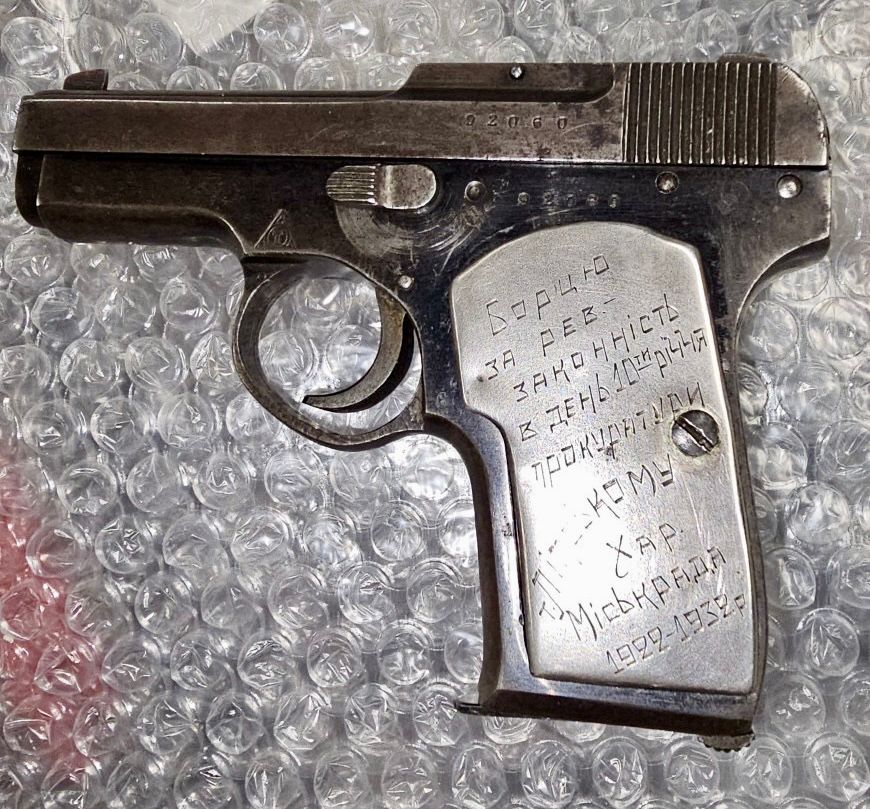
The first thing I noticed was the TOZ factory stamp above the trigger. It looks like a hole for a pin or a screw unless you know what you are looking at. The customer standing across my bench had no idea it was there.
He had brought me a Russian pistol he thought was from the 1940s. He knew it was old. He knew it was not cycling correctly. That was the full extent of what he knew.
This was not some ordinary old .25 ACP.
The pistol was a Tula-Korovin. Sergei Aleksandrovich Korovin designed it after training under John Moses Browning at the FN factory in Belgium. He took what he learned there and produced one of the first Russian semi-automatic pistols chambered in 6.35 mm Browning, what we call .25 ACP. It served as an officer's sidearm and was carried by agents of the NKVD.
This appeared to be a T2 model, the second variation out of three known versions. Most people have never seen one in person. A lot of them disappeared after the TT33 became the preferred Soviet sidearm. Some were destroyed outright.
The customer had no idea how rare it was. What he knew was that it was malfunctioning, and he wanted it fixed.
Once I started examining it, someone had already been inside it before it reached my bench. The magazine feed lips had plier marks on them. The feed ramp looked like somebody had taken a hand file to it. The mainspring was wrong: several pounds heavier than it should have been, which caused the slide to short-cycle and slam back into battery too fast.
The pistol was stovepiping almost every round.
He mentioned the cycling issue when he dropped it off, which told me he had probably already been loading snap caps or live rounds before bringing it in.
That happens more than people think.
The diagnosis was straightforward. The execution was not. With a firearm like this, you move carefully at every step because there is no parts supply to fall back on. A mistake here is not a trip to the distributor. It is a search that may not end.
I adjusted the magazine feed lips until both sides matched correctly. I polished the feed ramp with a Foredom tool instead of a hand file. Then I reduced spring tension by removing coils incrementally and test-firing after each adjustment. The process took several cycles before the pistol functioned correctly.
In the end, it worked the way it should have.
Then I gave the customer one instruction:
Do not shoot this pistol anymore.
Not because it was unsafe after the repair. Because it was too rare, too old, and too difficult to support with replacement parts. At one point I located a spare magazine for nearly three hundred dollars, and even that took work to find.
"Some firearms stop being range guns and become historical artifacts that still happen to function."
Some customers hear that and immediately do the opposite.
The owner took the pistol to the range and fired a full box through it. Then he brought it back and asked why it no longer worked.
The firing pin had snapped.
I have been looking for a replacement since. They are nearly impossible to locate. At this point the most realistic option is finding another Tula-Korovin and buying it for parts. My lathe is currently down, or I would already be making one.
That situation is not unusual.
Some customers will ask for professional advice and deliberately ignore every bit of it. Sometimes they get embarrassed and take the firearm to another gunsmith instead of coming back. More than once another smith in town has called me after finding my repair ticket still sitting inside the gun case.
Then we both laugh about the customer who thought they knew better.
Many firearm owners honestly do not understand what they have. I once had somebody bring me a World War II German Luger with SS markings and ask why it was not shooting the way they expected. My first question was what they expected. My second was why they were shooting it in the first place.
"Not every old firearm should still be treated as a range gun. Some deserve preservation more than use."
I started with firearms in 1983 as an 0311 Infantry Marine, and I have spent most of the forty years since then in some version of the same job: being responsible for weapons that other people carry. First at Guantanamo Bay during the Cold War. Then as a weapons instructor at Edson Range, Camp Pendleton. Then twenty-five years as an armorer and instructor with the Iowa Department of Corrections, retiring as a Captain. That background shapes how I see a firearm sitting on my bench. It is not just a repair ticket. It is something that matters, in ways the person who brought it in may not fully understand yet.
After retiring I attended Sonoran Desert Institute, graduating Magna Cum Laude, and continue working toward my Advanced Master Gunsmith certification through the American Gunsmithing Institute. Valhalla Gunsmithing LLC opened in 2024.
For gunsmiths starting their own shops, two things matter above everything else.
First, do your paperwork correctly. I use A&D bound books, gunsmithing logs, FastBound, and triplicate repair tickets. Some people call it overkill. When the ATF shows up for an inspection, you need to know where every firearm came from, where it went, and what was done to it. That is not overkill. That is the job.
Second, buy a real Foredom tool. Not a knockoff. A real Foredom will save you money in the long run, and I would estimate that over seventy-five percent of the custom parts work I do involves that tool at some point.
Somewhere in Iowa there is a Tula-Korovin with a snapped firing pin. It went to the range against the advice of the gunsmith who fixed it, and now it cannot be fixed again. Not without a part that does not exist on the open market, and possibly not at all.
That pistol survived the Soviet Union. It survived the Cold War. It survived whatever happened to it before it reached my bench.
It did not survive one box of ammunition fired by a man who thought he knew better.
If anybody reading this knows where a Tula-Korovin firing pin is hiding, I am interested. I have been looking for a while now.