There is a version of gunsmithing that looks like the work people imagine — fitting a barrel, timing a revolver, tuning a trigger to break clean at a specific weight. That work exists. It is satisfying. It is also maybe thirty percent of the job.
The rest is fasteners.
Specifically, it is screws that were staked in at the factory seventy years ago, screws that someone before you already chewed up with the wrong driver, screws on European shotguns with slots so thin that almost nothing off a rack fits them correctly. It is scope ring screws that have been torqued down by someone who didn't know what they were doing and are now rounded out past the point where a standard Allen key gets any purchase. It is, in short, the part of gunsmithing that nobody mentions when they talk about gunsmithing.
I have been at it for 45 years out of Albany, New Hampshire. I will tell you the most important tool in a gunsmith shop is a screwdriver. Not a lathe. Not a mill. A screwdriver and more specifically, a screwdriver that actually fits the screw you are trying to turn.
I use Grace screwdrivers. By far the best, followed by Brownells Magna-bits. Neither set, nor any other set on the market, covers every situation I run into. That has always been the problem.
"I have roughly three times the cost of each machine tied up in tooling, cutters, and fixtures. And that doesn't count the fixtures I couldn't buy and had to make myself."
Now I want to be clear about something before I go further. My milling machine and lathe are not optional. I could not do what I do without them. But people who don't work in a shop sometimes think you buy the machine and you're done. You're not even close to done. I have roughly three times the cost of each machine tied up in tooling, cutters, and fixtures on top of the purchase price. And that doesn't count the fixtures I couldn't buy and had to make myself. The machines are the foundation. The tooling is what makes them actually useful, and that bill never stops coming. I say that because it matters to how I think about the mill as a solution to the screwdriver problem.
The standard approach the one I used for most of my career is to clamp a machinist vee block in the mill vise, chuck up a carbide burr or a stone, and reshape the tip to fit the slot. With a dividing head you can do Phillips and Allen bits as well. It works. It is precise. But it is a setup operation. You are pulling the mill into a job that takes five minutes to do and fifteen minutes to set up for, and every time you do that you are spending time you probably didn't quote for.
Time is money. One-man shops learn that fast.
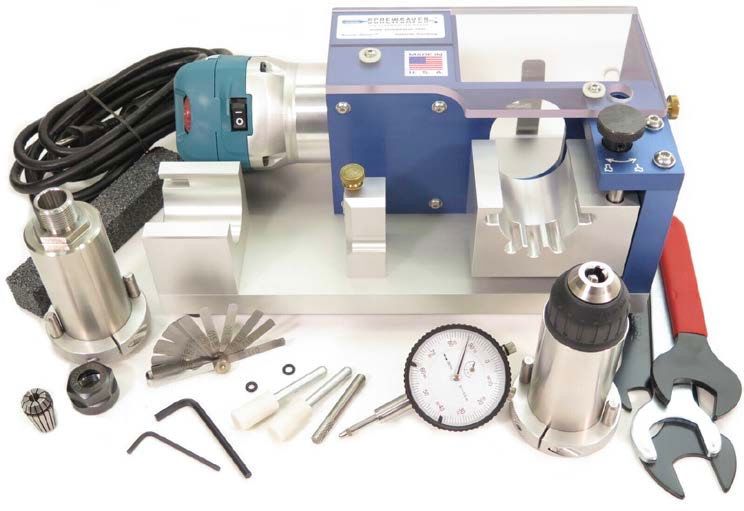
I was on eBay where a lot of parts for old guns end up, and where you occasionally find tooling that never made it into any catalog when I came across a machine called the Screw Saver. I studied the pictures. Watched the videos. I don't buy things on impulse, so I slept on it. The next morning I ordered the complete package and the Makita router the manufacturer recommends.
The Screw Saver is a small bench-mounted unit. The router drives a carbide burr. The fixture holds the bit at a controlled angle and lets you grind screwdriver blades to precise thicknesses without burning the steel burning it is how you ruin the temper and end up with a tip that looks right but won't hold up under torque. When everything arrived I set it up and went straight to the broken tool box on my bench. About 25 screwdrivers, all with damaged or wrong-profile tips. I spent an hour and a half working through them.
I was not disappointed.
"Take an Allen bit one size larger than the stripped head, grind it down to an oversized profile, and drive it into the damaged socket. The interference fit gives you enough purchase to back the screw out clean."
I have since taken tips down to .010 inch on the machine. That number matters if you work European shotguns. The slot tolerances on older Belgian and German guns are narrow enough that an improperly fitted driver will skate off and mar the finish before you even feel it happening. It's the kind of thing that reminds you why fit matters not as a concept, but on a specific gun, on a specific screw, right now.
The other application I keep coming back to is stripped Allen heads in scope rings. It walks in the door regularly. Someone installed their own scope, didn't use a torque wrench, went too tight chasing a zero, and now the hex socket is rounded past the point where a standard key gets any bite. The conventional fixes carry risk. Extraction bits work sometimes. Drilling is a last resort.
My fix: take an Allen bit one size larger than the stripped head, grind it down on the Screw Saver to an oversized profile, and drive it into the damaged socket. The interference fit gives you enough purchase to back the screw out clean. It's a bench operation. No mill setup. I've done it enough times now that it's just how I handle that problem.
The Screw Saver is not a tool with a high profile in the trade. I consider it a best-kept secret, and I mean that. It is made in the United States. The owner is good to work with. It is not cheap, but I think about tooling cost the same way I think about the mill against the time it saves and the problems it solves.
Fitting drivers properly is not glamorous work. It is not the kind of work that gets photographed, advertised, or talked about much outside the shop. But every gunsmith knows the truth: the job often comes down to whether the tool fits the screw before the screw gives up. I've been modifying tips for 45 years. I'm just doing it faster now.