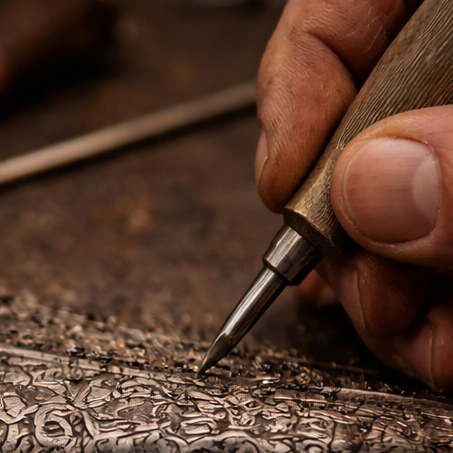
The gun arrives on my bench. Before I pick up a graver, I inspect the surfaces. I am looking for flat. True flat, not buffed flat, not sanded-with-whatever-was-on-the-bench flat. What I find tells me immediately whether the gunsmith who prepped this work understands what an engraver needs, or whether I am about to have a conversation with the customer about additional time and cost they did not plan for. That conversation happens regularly. I am not writing this to criticize gunsmiths. I have spent twenty years building working relationships with them, and the best jobs I have ever turned out came from gunsmiths who understood their role in the process and executed it cleanly.
I am writing this because metal prep for engraving is a specific discipline with specific requirements, and it is not taught in most gunsmithing programs. The gaps are not from carelessness. They are from the absence of information passing between trades. Here is the standard. Every firearm coming to an engraver should arrive fully disassembled, finish removed, bluing stripped, and metal clean. That is the baseline. What most gunsmiths miss is what comes after the strip: the surface work. Every flat that will carry engraving needs to be brought to true flat by hand. Block and sandpaper. Sharpening stones for tighter areas. That is it. No shortcuts.
“The single most common error I receive is buffing wheel prep. It will end the conversation before the engraving begins.”
A buffing wheel does not know where the flat ends. It rounds edges, creates waves across panels, and leaves a surface that reads as polished but is geometrically compromised. Under a graver, those waves telegraph into every line. A scroll that should read as crisp will float. Gold inlay borders will not seat cleanly.
The prep damage does not stay hidden under the engraving. It comes through it. The same applies to belt sanders, orbital tools, and anything else with a mechanical action that does not give the operator direct tactile feedback on the surface condition. Round surfaces are the exception: I can handle those on a lathe, and I often do. But the flat panels, the frame faces, the top straps, the grip straps, those require hand work, full stop.
The finish removal matters too, and the sequence matters. All engraving should be done in the metal white stage. Finish off, metal clean, before the graver touches the surface. A gun that still has case color, bluing, or any coating remaining in the recesses creates contamination risk during cutting and compromises the visual read of the engraving as it develops. I need to see the steel. All of it. What I tell gunsmiths who want to develop a clean handoff process: treat the engraving blank the way you would treat a surface you are about to fit a precision part to. You would not lap a slide on a buffed surface. You would not fit a barrel to a receiver that had been rounded on a wheel. The same discipline applies here. Flat is flat. It either is or it is not.
“A gun prepped correctly costs me nothing extra. A gun prepped incorrectly costs both of us.”
When prep arrives wrong, I do it myself. I charge for it, because there is no other option. The engraving cannot go over a compromised surface, and I am not going to deliver work I cannot stand behind. I have re-polished complete guns from scratch, sandpaper only, by hand, because the alternative was sending the job back or cutting into a surface that would undermine the finished piece. Neither of those is acceptable on a commissioned work.
The time cost is real. On a job where prep adds four to six hours, that is time the customer did not budget and did not expect. It is a conversation that strains the referral relationship between the gunsmith and the engraver, not because anyone acted in bad faith, but because the standard was not communicated before the gun left the shop. If the prep is wrong, everything that follows is compromised.
The fix is simple. Talk before the job moves. If a customer is commissioning engraving and routing the work through your shop, call the engraver before you strip the gun. Get the prep spec directly. Every engraver has preferences on grit progression, on how they want the recesses handled, on whether they want the small parts left assembled or broken down completely. That five-minute call eliminates the four-hour correction.
The three-stage sequence that produces the best results every time: engraver handles the work in the white, qualified firearms finisher handles bluing or coating after engraving is complete, gunsmith does final assembly. Each specialist owns their stage. No overlap, no assumptions about what the next person in the chain can correct.
Where this breaks down is at the finish stage. A finisher who has not worked alongside hand engraving before will treat the engraved surface the same way they treat bare metal. They will run a polishing cloth across cut borders. They will use compounds that fill fine line work. I have seen completed engraving degraded at the finish stage because no one told the finisher what they were handling. That is a communication failure, not a competence failure, and it is preventable.
“The work survives the chisel. Whether it survives the rest of the process depends on the people in the chain.”
For gunsmiths who want to build a referral relationship with an engraver and keep it clean: learn the prep standard, communicate it to your customers before they commission the work, and call before you send the gun.
The jobs that come in right go out right. The customers come back. The referrals compound. Twenty years in, the best thing a gunsmith has ever said to me was: tell me exactly what you need and I will send it to you that way. That is a professional. That is a working relationship. That is how the craft moves forward.